Utah Boiler ExpertsHydronic Heating
Park City · Heber · The Wasatch Back

Snow-melt systems for real Utah winters.

Hydronic snow-melt for driveways, walkways, and steps. Properly engineered for high-altitude Wasatch winters, with smart sensor controls that don't waste fuel. Park City, Heber, Midway, and the Wasatch Front.

125–200 BTU/sq ft properly sized 50-year tubing life Smart sensor controls — fires only when needed Pairs with radiant + DHW

Why snow-melt makes sense in Utah

A standard residential snow shovel can clear about 600 lbs of snow before most people quit. A typical Park City storm drops 10–15 inches across a 1,500 sq ft driveway — call it 4,500 lbs of snow to move. Once a week. For four to five months.

That's why, in steep mountain driveways and on properties where snow falls faster than you can clear it, snow-melt isn't a luxury — it's the only system that actually keeps things usable through the winter.

The math gets stronger when you consider:

  • Ice liability — a single slip-and-fall at the entrance is a five-figure problem.
  • Salt damage — Utah's heavy use of road salt over winter destroys concrete in 10–15 years. Snow-melt removes the need for any salt.
  • Resale value — Park City and Deer Valley homes with snow-melt sell measurably faster and at a premium over comparable homes without.
  • The 6 a.m. problem — if you've ever shoveled the driveway before work, you understand the value of waking up to clear pavement.

How a hydronic snow-melt system works

PEX tubing in the slab

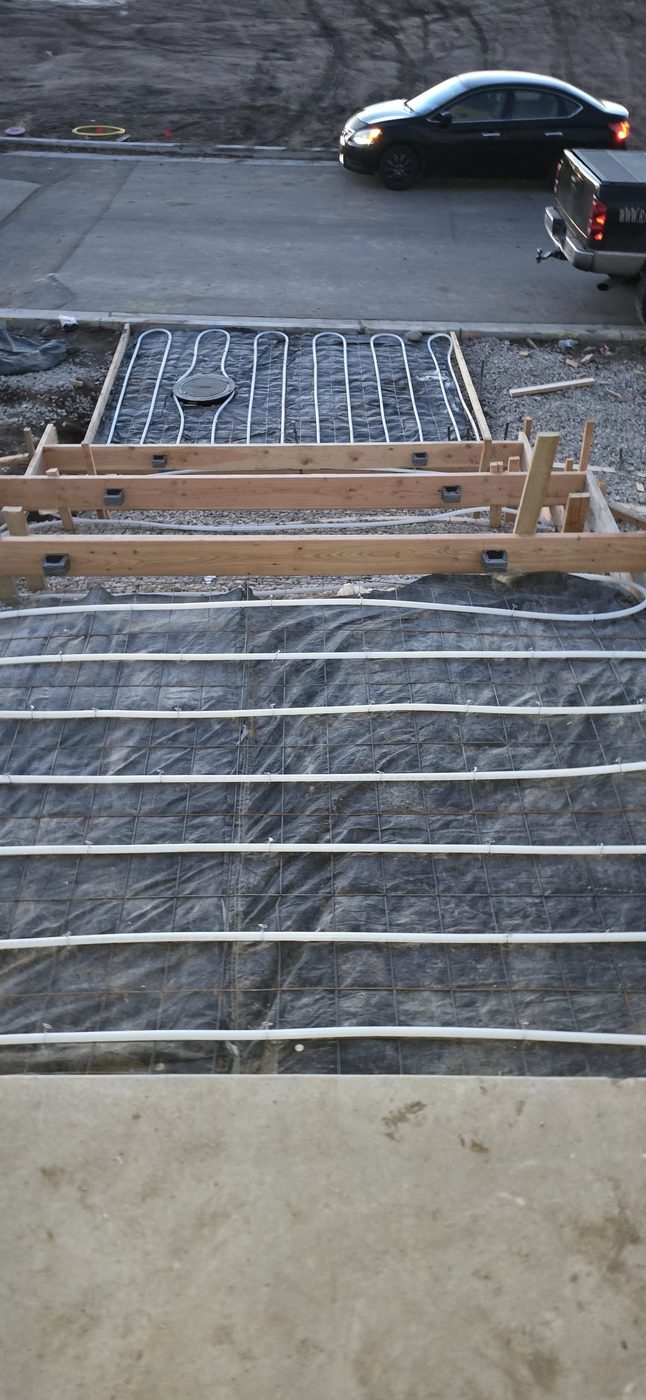
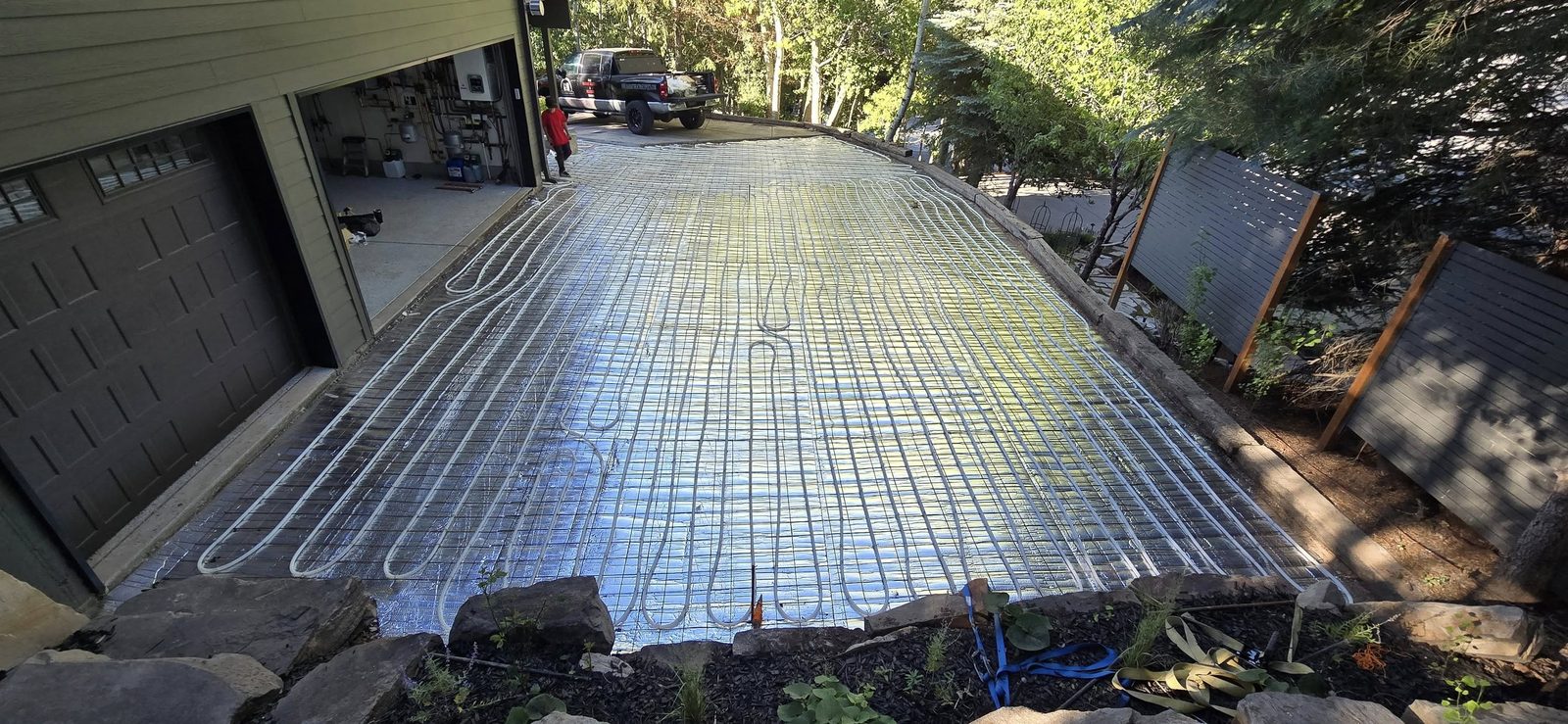
1/2" or 5/8" PEX-A tubing tied to rebar before concrete pour, or laid in bedding under pavers. Spacing typically 6"–9" on center depending on design load.

Glycol mix in the loop

Typically 40–50% propylene glycol mixed with water. Provides freeze protection down to -30°F or lower, even when the system isn't running.

Boiler heats the loop

Either a dedicated snow-melt boiler or a shared boiler with a stainless heat exchanger isolating the glycol loop from the home heating loop. Supply temperatures run 90–140°F depending on slab temperature.

Sensors trigger melt

Pavement sensor measures slab temperature AND detects moisture. Aerial sensor reads air temperature and humidity. Controller fires the system only when actual snow or freezing rain is present — no wasted gas.

Design decisions that matter

BTU per square foot

Snow-melt loads are 5–8x what home radiant heating requires per square foot. Typical Utah design targets:

  • Class I (residential, lower priority): 100–125 BTU/sq ft
  • Class II (residential, standard): 125–175 BTU/sq ft
  • Class III (steep driveways, ADA access, commercial): 175–225 BTU/sq ft

For Park City and Deer Valley, we typically design Class II or III given the snowfall volumes. Generalist installers often undersize at 100 BTU/sq ft, which works fine in Salt Lake Valley but underperforms in real Wasatch winters.

Zone the slab, don't melt the whole thing

You don't need to melt the entire driveway. Zoning into "wheel paths only" or "main driveway plus walkway, skip the apron" cuts both up-front cost and operating cost dramatically. For a 1,500 sq ft driveway, a smart zone design might actively heat only 900 sq ft — keeping cost down without sacrificing usability.

Heat-source sizing — don't undersize

A 1,500 sq ft Class II driveway needs roughly 200,000–260,000 BTU of heat-source output. Most residential boilers are 80,000–140,000 BTU. That math is why most snow-melt systems need a dedicated boiler or a serious boiler upgrade. We don't pretend otherwise.

"We've taken over a lot of failed snow-melt systems. Most failures are sizing — both the BTU output and the slab spacing. Get the design right and the rest follows."

Snow-melt + radiant combo systems

The premium configuration for new construction in Park City, Deer Valley, Promontory, and Heber Valley: a single mod-con boiler running radiant floor heat and snow-melt simultaneously, with a buffer tank smoothing the loads. The radiant side runs at 110°F supply, the snow-melt at 140°F, isolated by a heat exchanger.

Properly designed, this configuration uses less gas annually than running a separate furnace + electric snow-melt + electric water heater. It's the right answer for a luxury mountain home.

Snow-melt cost in Utah

Project typeInstalled range
Heating system per sq ftPEX, glycol, manifold, controls — not concrete$18–$28 / sq ft
Front walkway & steps~200–400 sq ft, smaller boiler share$8,000–$16,000
Typical Park City driveway~1,500 sq ft, dedicated boiler$35,000–$55,000
Driveway + walkway + stepsFull estate, ~2,500 sq ft$48,000–$80,000+
Boiler upgrade if neededTo handle combined snow-melt load+$8,000–$18,000
Annual operating costAverage Park City winter, 1,500 sq ft$400–$900/yr

Where we install snow-melt

Snow-melt installs run heavy in the mountain markets. Full list on the service area hub.

Common questions

Hydronic snow-melt installed under new concrete typically runs $18 to $28 per square foot for the heating system alone (not including the concrete pour itself). A typical 1,500 sq ft Park City driveway runs $35,000 to $55,000 turnkey, including a dedicated boiler or boiler-share with heat exchanger. Walkways and stair systems are smaller and proportionally less.
With smart pavement-sensor controls, a typical Park City snow-melt event runs roughly $8 to $20 in gas, depending on the storm size and area covered. Annual operating cost in a heavy-snow Park City season is typically $400 to $900 for a 1,500 sq ft driveway. Systems left on "idle mode" all winter cost more — we configure smart controls that only fire during actual precipitation.
Sometimes — depends on the boiler's BTU output and whether the existing system has enough overhead capacity. Snow-melt loads are large (125–200 BTU per sq ft of melt area). A 100,000 BTU boiler heating a 2,800 sq ft house typically can't handle 1,500 sq ft of snow-melt on top. A heat exchanger isolates the glycol-charged snow-melt loop from the home's heating loop. We evaluate this honestly — if a dedicated boiler is needed, we say so.
A properly designed system at idle mode keeps the slab above freezing and starts active melt as soon as precipitation begins. Typical melt-through during the storm — meaning the slab stays clear as snow falls — works well up to about 1 inch per hour of snowfall on a typical Park City system. Heavier sustained snowfalls may accumulate slightly during the peak and clear within an hour after.
Yes. PEX tubing is laid in the bedding sand or in a thin concrete bed under the pavers. The system works well under pavers though response time is slightly slower than slab installs because heat conducts through the bedding before reaching the surface. Common on luxury Park City driveways where the paver aesthetic is preferred.
A properly sized system keeps a driveway clear during typical Wasatch storms. During an extreme event — say a major Park City storm dropping 18 inches in 12 hours — accumulation can outpace melt capacity. A few inches may sit on the slab temporarily, then clear within hours of precipitation stopping. The system is doing its job by preventing the ice base that forms when snow compacts underfoot.
The PEX tubing has a 50-year+ service life. The mechanical components — boiler, pumps, controls, sensors — typically need attention every 10–15 years. Snow-melt sensors in particular need replacement on a roughly decade cycle as they degrade from exposure. Pavement sensor failure is the single most common service call we run on installed systems.
Related services

Pairs with the rest of the hydronic stack.

Snow-melt rarely lives alone in a custom home. Most installs combine with at least one of these:

Stop fighting winter

Snow falls. The driveway stays clear.

New construction or retrofit. Park City, Heber, Wasatch Back. We do the design, we do the install, we service what we install.

📞Call (801) 685-3976