
Installation is a different job than replacement
People sometimes ask about "installation" when they mean swapping a failed boiler — that's replacement. Installation, in our usage, means a hydronic system going into a new build, an addition, or a home converting from forced air. Different timeline, different scope, different people involved.
The biggest differences:
- Design phase matters. Replacement works with existing piping. Installation starts from "what does this house need?" — heat-loss calculation, zone planning, manifold layout, control strategy. The decisions made here echo for 20 years.
- Coordination with other trades. Radiant tubing has to go in before slab pour. Piping has to go in before drywall. Venting paths need to be agreed with framing. Gas line size matters. We're one of 8+ trades on the job.
- Scope often goes beyond the boiler. Radiant tubing, manifolds, indirect water heater, snow-melt integration, controls. The "boiler installation" is often a 5-figure piece of a 6-figure hydronic system.
How a new-construction install unfolds
Design phase
Before framing. We work from plans: heat-loss calc, zone layout, equipment selection, mechanical room sizing, gas line, venting paths. Documented and quoted.
Rough-in
Radiant tubing tied to rebar before slab pour. PEX manifolds located. Rough copper or PEX runs to baseboards or panel radiators if used.
Mechanical room set
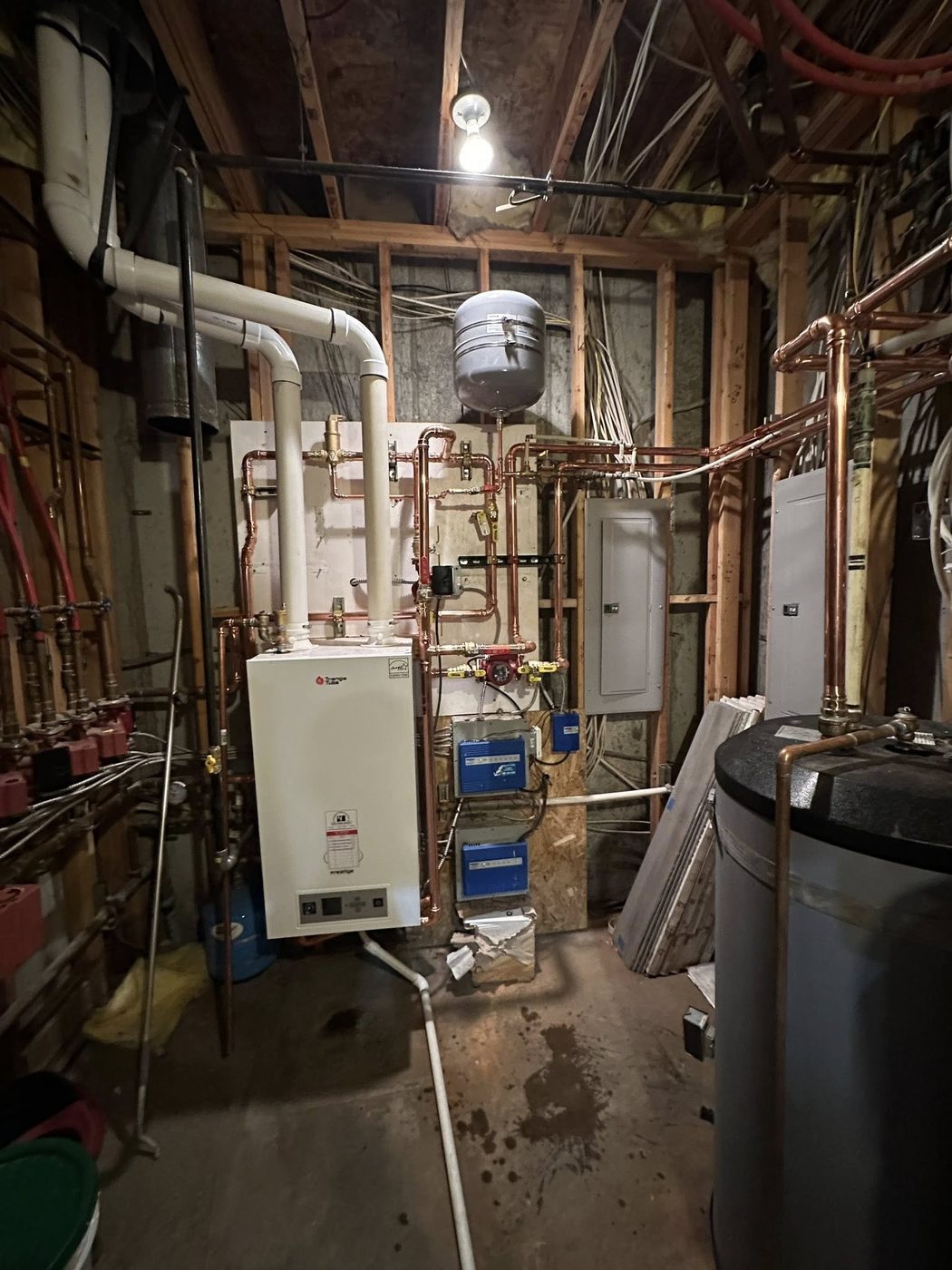
After drywall and finish. Boiler, indirect tank, manifolds, controls, expansion tanks all installed. Piped, vented, gas-connected, wired.
Commission & turnover
Combustion analysis, leak test, control logic verification, outdoor reset configuration, owner walkthrough. Documentation packet. Manufacturer warranties registered.
What we install
For new construction, the boiler is usually one piece of a larger system. Typical scope:
- Modulating-condensing boiler — sized to the actual heat load, not a rule of thumb. Lochinvar Knight, Triangle Tube Prestige, Viessmann Vitodens, Navien NHB, Weil-McLain Eco — selection depends on the home, budget, and how you'll use it.
- Radiant floor heating — see the radiant pillar. In-slab is the standard for new builds.
- Indirect water heater — heated by the boiler, dramatically faster recovery than a tank, longer life. Triangle Tube Smart, Lochinvar SquireXL.
- Snow-melt integration — for Park City and Heber luxury homes. More on snow-melt.
- Outdoor reset and smart controls — boiler trims supply temperature based on outdoor conditions. Standard on every install we do.
- Magnetic dirt separator — at the boiler return, catches scale and debris. Big factor in long heat-exchanger life.
"Most failed new-build hydronic systems we take over weren't installed wrong. They were designed wrong. Get the design right at the desk and the install is easy."
Who this is for
- Custom home builders. Park City, Heber, Cottonwood Heights, Draper, Holladay. We're brought in by the GC during plan review.
- Architects. We help with equipment specs, mechanical room sizing, and provide BTU calculations that match the design intent.
- Homeowners doing a major addition. Adding 1,500 sq ft means re-running the heat-loss calc on the existing boiler. Often the existing unit needs replacement, sometimes it can carry the load.
- Homeowners converting from forced air to hydronic. Rare but it happens — usually after one too many years of dry winter air and dust.
Who this isn't for
- If your existing boiler died and you need a new one in 48 hours — that's replacement, not installation.
- If you want the cheapest possible quote — we're not the cheapest. We're going to be in the middle on price and at the top on engineering depth. There are companies that will install a boiler for less than we'll quote. Many of those installs are the ones we end up servicing.
- If you're set on a brand that we have warranty/service concerns about — we'll tell you. We're brand-agnostic in principle but we won't install something we don't believe in.
Where we install
Custom-home installs across Utah, concentrated in the higher-end markets where hydronic systems are the standard.