The three water heater types we service
What's in your basement isn't all the same problem. We service all three modern residential types and the indirect tanks paired with hydronic boilers — each has a distinct failure profile, particularly in Utah's hard-water environment.
Tank-style water heaters (gas & electric)
The traditional 40, 50, or 75-gallon cylinder that's been the default for decades. Gas-fired or electric. Stores hot water continuously. Most common failures in Utah: anode rod depletion (which leads to tank corrosion), pressure-relief valve failure, dip tube degradation, gas valve, thermocouple, and lower element on electric units. Typical service life in Utah: 8-12 years, shorter without anode maintenance because the hard water aggressively attacks the tank lining once the anode is consumed.
Tankless (on-demand) water heaters
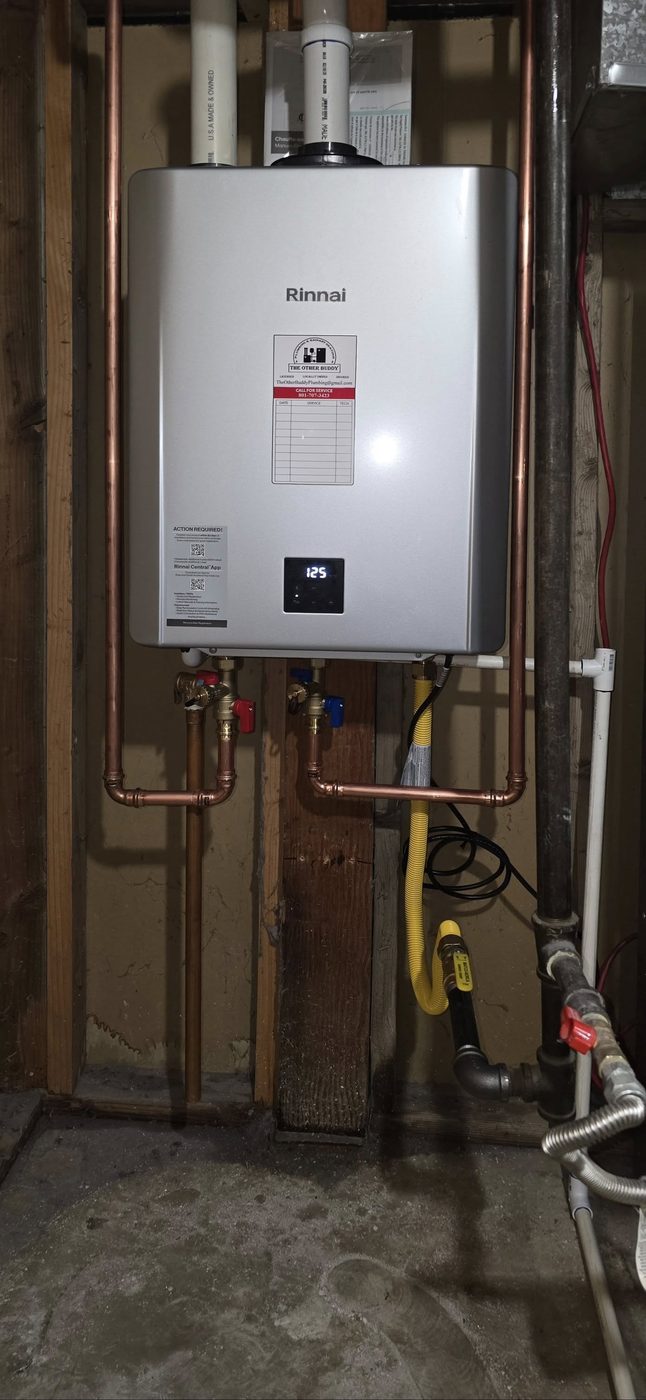
Wall-mounted units that heat water as it flows through a heat exchanger. Rinnai, Navien, Noritz, Bosch, Takagi, Lochinvar. No tank to corrode. Common failures we see: heat exchanger scale buildup (the dominant Utah issue), flow sensor failure, ignition assembly fouling, gas valve, and condensate drain blockage on condensing models. Service life: 15-22 years with annual descaling — significantly shorter without it.
Hybrid heat pump water heaters
Newer technology — uses a heat pump to move ambient heat into a stored tank. Roughly 3x more efficient than a standard electric tank. Common in newer homes and as upgrades for utility rebates. Failures: compressor issues, fan motors, refrigerant problems (requires HVAC-side service), and electric element backup. Service life: 10-15 years currently — the technology is still maturing.
Indirect tanks paired to boilers
The hydronic specialty. Lochinvar SquireXL, Triangle Tube Smart, Heat-Flo, and similar — stainless tanks heated by the boiler via an internal heat exchanger. No combustion, no separate fuel input. Long-lasting (often 25+ years) because the tank doesn't fire. Failures usually involve the boiler-side circulator, the aquastat, or the dip tube. We've been servicing these for as long as we've been doing hydronics.
Common Utah-specific water heater issues
Slow recovery / lukewarm hot water
Almost always scale-related in Utah. Tank units develop a sediment layer on the bottom that insulates the burner flame from the water above; tankless units develop scale in the narrow heat exchanger passages. Either way, the unit has to work harder to heat the water and may never reach the setpoint under load. Fix: flush a tank unit (sediment) or descale a tankless. We do this routinely.
Pressure-relief valve discharging
The TPR valve at the top of a tank heater opens when temperature or pressure exceeds safe limits. Discharge can mean a real overheating problem (gas valve sticking on, thermostat failure) or just an aging valve. We diagnose by checking system temperature/pressure and replacing the TPR if the unit is OK. Never plug or cap a TPR discharge line — it's there for a reason.
Tankless lockout codes
Every tankless brand uses fault codes to communicate what went wrong. Common Utah codes: Rinnai 11 (no ignition — often flame rod fouling), Navien 760 (heat exchanger overheat — usually scale), Noritz 90 (combustion fan), Bosch C7 (condensate). Reading the code properly is the diagnostic shortcut; many techs just clear it and hope.
Anode rod depletion
The sacrificial magnesium or aluminum rod inside every tank water heater that corrodes instead of the tank steel. Once the anode is consumed (typically 3-5 years in Utah's hard water), tank corrosion accelerates dramatically. We check the anode on every tank service call and replace it preventatively — a $90-$160 part that adds years to the tank.
Leaks at fittings vs tank-body leaks
Critical distinction. Leaks at the supply lines, drain valve, or TPR are routine repairs. A leak through the tank wall itself is the end of the line — tank steel doesn't get patched. We confirm with a smoke test and clean inspection before quoting; sometimes what looks like a tank leak is actually a slow drip from a fitting above that's been running down the side.
Tankless freezing in unheated spaces
Tankless units in garages or unheated mechanical spaces can freeze in Utah winters, fracturing the heat exchanger. Modern units have freeze-protection heaters but they require AC power continuously. We see at least a dozen freeze-cracked tankless units per winter — almost all installed by techs who didn't understand the freeze-protection requirement.
"If your tankless wasn't descaled this year and you're in Utah, the scale is already costing you efficiency and shortening the unit's life. We caught one Park City home where a 3-year-old tankless had lost 40% of its capacity to scale. Two-hour descale brought it back."
Water heater repair pricing
Brands we service
All major water heater brands sold in Utah. Tankless: Rinnai, Navien, Noritz, Bosch, Takagi, Lochinvar. Tank: Bradford White, A.O. Smith, State, Rheem, Ruud, GE. Indirect tanks paired with boilers: Lochinvar SquireXL, Triangle Tube Smart, Heat-Flo, Buderus.
When to replace instead of repair
- Tank itself is leaking through the steel (not fittings) — replace
- Tank unit over 12 years old with major component failure — math usually favors replacement
- Tankless unit with cracked heat exchanger (freeze damage) — replace
- Repeat failures within a single year — system is past its useful life
- Hybrid units over 12 years with compressor or refrigerant issues — replace
For everything else, repair is usually the right call. We provide both quotes when the decision is on the line.
Where we service water heaters
All 26 cities across Salt Lake Valley, Park City & Summit County, the Heber Valley, Utah Valley, and Davis & Weber counties. Full service area list →